You've launched your IT service portal. Tickets are supposed to drop. Self-service should surge. But adoption is stuck in neutral, and your team is still drowning in routine requests.
Improving IT service portal adoption rates isn't about adding more features or cranking up the marketing blast. It's about making your portal so useful, accessible, and trustworthy that employees naturally reach for it first. According to research, 73% of organizations prioritize self-service portal adoption as a critical initiative to reduce resource strain and operational costs. The gap between intention and execution, though, is real.
Related: How to Increase IT Helpdesk Portal Adoption in 2026
Related: IT Service Portal Modernization Guide: Best Practices for 2026
Related: IT Service Management Portal Best Practices for 2026
Related: Improving Freshservice Portal Engagement Metrics: A Guide
Related: IT Service Management Portal Redesign: Complete Strategy Guide
Related: Best Employee Self Service Portal Design & UX Guide 2026
Here's how to close that gap.
1. Make Your Portal Instantly Recognizable
Generic portals fail because they look like every other tool in your tech stack. When employees log in, they see a bland interface that screams "corporate software" instead of "my company's help desk."
Brand your portal with your company colors, logo, and visual identity. Add department-specific sections if you're large enough. When your portal looks and feels like part of your company's ecosystem instead of a third-party tool, adoption naturally climbs because employees feel like it's "theirs."
This isn't cosmetic. Ascend Portal Experience transforms generic IT helpdesks into branded employee experiences that actually encourage self-service behavior. The psychology is simple: people engage more with tools that feel intentional and professional.
Related: Best Service Portal for Freshservice: Premium Employee Experience Design
Related: Best Self Service Helpdesk Portal Design for Freshservice
2. Build a Self-Service Knowledge Base That Actually Works
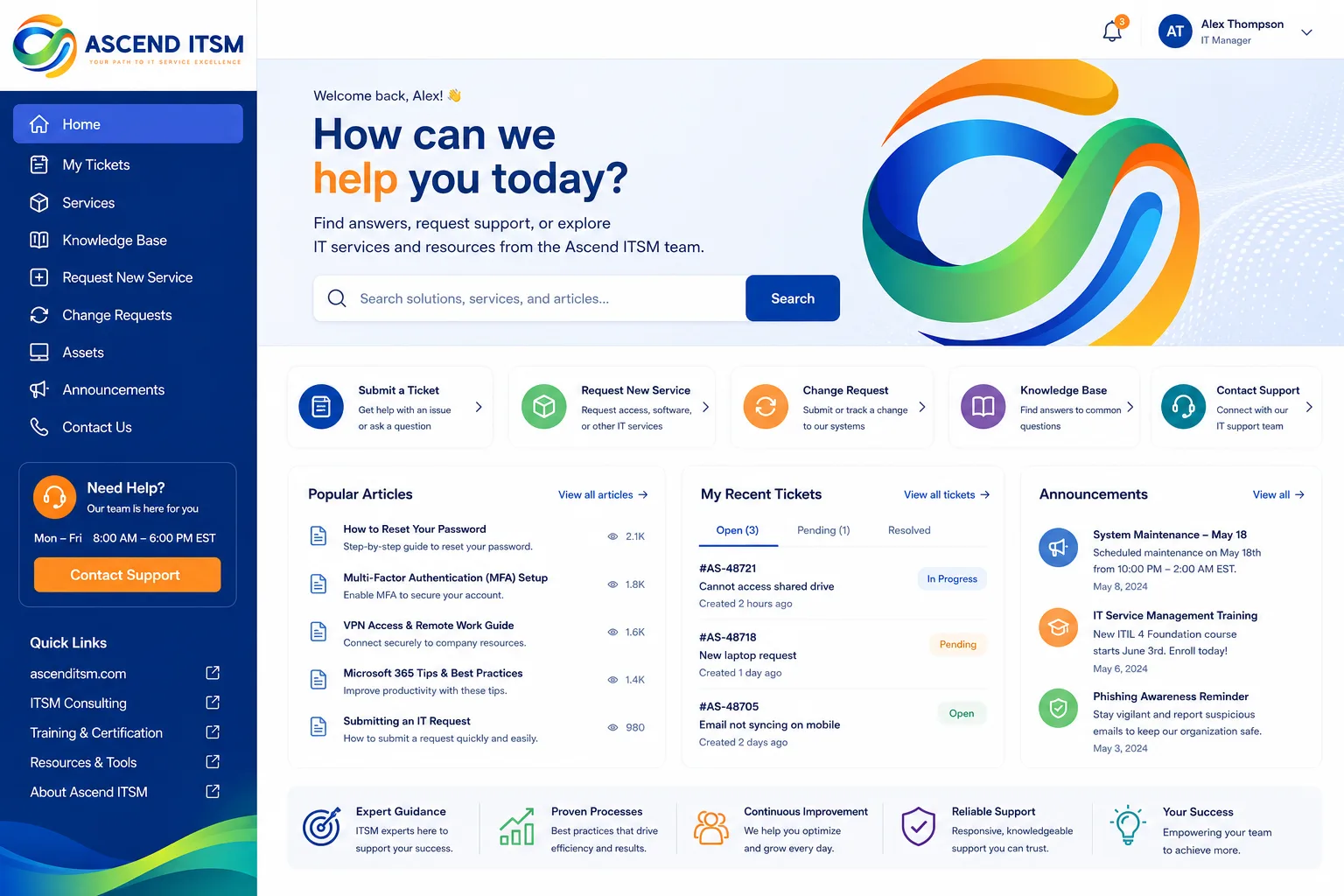
Your knowledge base is only as good as your employees' ability to find answers in it. If search returns junk results and articles are buried under outdated content, adoption crashes immediately.
Structure your knowledge base around real employee questions, not IT department language. Use simple titles like "How to reset your password" instead of "Authentication credential management procedures."
Then measure knowledge base performance using these adoption metrics:
- Search quality (what percentage of searches return useful results?)
- Content gap identification (what questions do employees ask that you don't have answers for?)
- Self-resolution rates (how many issues are solved in the portal without a ticket?)
- Usage rates (total portal sessions and session depth)
Track these numbers monthly. You'll spot knowledge base blindspots fast and plug them before frustration sets in.
3. Enable Feedback Loops and Close Them Quickly
Feedback loops are essential to portal adoption. Let employees rate responses, flag outdated information, and suggest improvements. Then actually implement those suggestions.
Related: How to Improve Employee Portal Experience: 5 Proven Strategies
If an employee flags an article as outdated, your team should update it within days. If someone suggests a new FAQ topic, add it within a week. When employees see their feedback turn into action, they trust the portal more and use it more frequently.
Without a feedback mechanism, your portal becomes a static archive that rots over time. With one, it becomes a living resource that improves because your employees shaped it.
4. Implement AI-Powered Chat Support (But Do It Right)

AI is transforming support faster than most IT teams realize. According to industry trends, AI agents are replacing legacy chatbots and will eventually play a role in 100% of customer interactions by 2026.
Want to work together?
Get in Touch →Your employees expect a chatbot on your portal. It should resolve common issues instantly—password resets, software download links, ticket status checks, FAQs on common policies.
But here's the catch: a bad chatbot hurts adoption more than no chatbot at all. Train yours on real employee questions and common failure scenarios. If your chatbot escalates to a human, make sure that handoff is seamless and the human has full context.
A well-implemented AI agent cuts down repeat questions and frees your support team to handle complex issues. That's the adoption win you want.
5. Create a Rollout Plan with Built-In Incentives
Launching a portal all at once rarely works. Employees ignore change notifications and stick with old habits.
Instead, phase your rollout by department or use case. Start with your most tech-forward team. Let them use the portal for two weeks, collect feedback, iterate fast, then expand to the next group.
During the rollout, make self-service more attractive than opening a ticket:
- Offer instant answers via the portal (vs. a 4-hour ticket queue)
- Show employees how much faster they can solve problems themselves
- Feature employee success stories in your IT newsletter
- Run a pilot program with early adopters who evangelize the portal to their peers
Incentives aren't always monetary. Sometimes they're just speed and convenience.
6. Measure Adoption Metrics Constantly
You can't improve what you don't measure. Set baseline metrics before launch and track them weekly:
- Portal logins per week
- Average session duration
- Percentage of issues resolved via self-service
- Ticket volume trends (are they dropping?)
- Employee satisfaction with portal experience
Use customizable templates to document these metrics in a Self-Service Portal Adoption Review. When you see a dip, investigate immediately. Maybe the knowledge base search broke. Maybe an article went stale. Maybe employees didn't get trained on a new feature.
Data tells you where to focus next.
7. Invest in Ongoing Portal Improvement, Not Just Launch

Most organizations fail at portal adoption because they treat launch as the finish line. They build it, promote it once, then move on. Six months later, adoption has flatlined.
Portal success depends on responding to employee feedback and continuously updating content based on usage patterns. Act on user input every single week. Update outdated articles. Add new FAQ topics based on common questions. Fix slow search results. Improve the mobile experience.
End-user experience matters because focus on portal traction and user experience drives sustained adoption rates. Small improvements compound over time.
This is where organizations often struggle. They lack the bandwidth or expertise to maintain momentum. If your team is stretched thin, Ascend Portal Experience specializes in building and maintaining high-adoption portals that actually reduce your support workload instead of adding to it. The Ascend Professional Portal Package handles the heavy lifting so your team can focus on strategy.
Why Most Portal Adoption Initiatives Fail
Here's the honest truth: most IT teams underestimate the work it takes to drive real adoption. They assume a well-built portal sells itself.
It doesn't.
Adoption fails when:
- The portal looks generic and uninviting
- Search and knowledge base aren't user-tested
- Employees get zero feedback from the IT team
- Support times are so slow that the portal feels pointless
- Updates stop after launch
- No one measures whether adoption is actually happening
Every one of these is fixable. The organizations winning at portal adoption treat it like an ongoing product, not a one-time IT project. They prioritize employee experience. They measure relentlessly. They iterate weekly.
If you're struggling to move the needle, it's not because portals don't work. It's because the portal hasn't been optimized for your specific employees yet.
The Bottom Line: Adoption Requires Intentional Design
Improving IT service portal adoption rates isn't mysterious. It requires clear design choices, employee-centric feedback, and relentless measurement. It means treating your portal like a product your employees actually want to use instead of a tool they're forced to tolerate.
Start with branding and knowledge base quality. Add feedback loops. Implement smart AI. Then measure everything and improve it weekly. That's the playbook that works.
Organizations that nail this see ticket volumes drop by 30-40%, employee satisfaction spike, and IT teams finally get back to strategic work instead of repetitive support.
What's the fastest way to improve portal adoption in the first 90 days?
Start with your knowledge base. Audit every article for outdated information, rewrite titles for clarity, and test search functionality with real employees. Fix the top 20% of knowledge base problems and you'll see adoption jump immediately. It's the highest-ROI quick win.
How much can we expect adoption to improve with AI chat?
A well-trained AI chatbot typically resolves 20-30% of support requests automatically, freeing your team for complex issues. But a poorly trained one will frustrate employees and tank adoption faster than no chatbot at all. Quality of training matters far more than the technology itself.
Should we force employees to use the portal or incentivize adoption?
Incentivize. Forcing adoption creates resentment and employees find workarounds. Make the portal faster and more convenient than the alternative (opening a ticket) and adoption follows naturally. Speed is your strongest incentive.
How often should we update the portal to maintain adoption?
Minimum weekly. Review feedback, update outdated articles, add new FAQs based on common questions, and fix any technical issues. If your team can't commit to weekly iteration, you'll see adoption plateau within 6 months. A stale portal is a dead portal.