
A helpdesk portal transformation strategy isn't just about picking new software. It's about fundamentally reshaping how your employees interact with IT support—moving from clunky, impersonal interfaces to branded, intuitive experiences that actually get used.
If your current helpdesk portal feels like an afterthought, you're not alone. Most organizations inherit whatever default setup came with their ITSM platform and call it done. But the data tells a different story: organizations that prioritize portal support see dual benefits—better operational performance and stronger employee satisfaction simultaneously.
Let's walk through the transformation strategy that actually works.
1. Audit Your Current Portal Setup
Before you can transform anything, you need to understand what's actually happening right now.
Start by asking hard questions: How many employees use your portal versus calling the helpdesk directly? What's your ticket resolution time? How often do users abandon requests mid-submission? Are there common pain points in your ticket creation flow?
Related: Best IT Helpdesk Portal Modernization for Freshservice Users
Related: Best ITSM Functions for Freshservice Portal Success
Related: Best IT Helpdesk Portal Redesign Process for Freshservice
Related: Best Self Service Helpdesk Portal Design for Freshservice
Related: Branded Helpdesk Portal Best Practices for Freshservice
Related: How to Rebrand Freshservice Helpdesk Portal in 2026
Related: ITSM Helpdesk Portal Design & Branding Guide 2026
This isn't hypothetical—you need actual data. Pull reports from your ITSM platform. Survey 20-30 employees about their experience. Watch someone try to submit a ticket without helping them. What breaks?
Related: Best Employee Helpdesk Portal User Experience in 2026
Most organizations discover that their existing portal handles maybe 30-40% of potential self-service requests, with the rest flowing through email or phone because the portal is too confusing or slow. That gap is where your transformation strategy lives.
2. Define Your Digitalization Roadmap
Transformation requires a structured plan, not wishful thinking.
Your digitalization roadmap should outline three phases: assessment (what we just did), implementation (what you're building), and optimization (measuring results and iterating).
Set specific goals for each phase. Phase one might be "reduce direct helpdesk contacts by 25% through improved portal UX." Phase two could be "implement AI-powered ticket categorization and self-help suggestions." Phase three tracks adoption metrics, agent productivity gains, and employee satisfaction scores quarter over quarter.
Related: How to Increase IT Helpdesk Portal Adoption in 2026
Without a roadmap, transformation becomes a scattered collection of random fixes. With one, it becomes a business initiative with measurable outcomes.
3. Choose Your Platform Architecture Carefully
If you're already using Freshservice as your ITSM platform, your architecture decision is partially made—but how you layer customization on top of it matters enormously.
Some organizations try to do everything inside the platform's native interface. Others build a custom portal layer that connects to Freshservice through APIs, allowing total design control while keeping backend stability. There's no universal right answer, but there are trade-offs.
Native implementations move faster but limit your ability to differentiate. Custom portals take longer and cost more upfront but deliver branded experiences that drive adoption. Most mid-to-large enterprises lean toward the custom approach because the ROI on employee adoption justifies the investment.
The key: your architecture should support automation, integration with your existing tools, and future scaling. If you're building something that can't evolve as your needs change, you're setting yourself up for another painful rebuild in three years.
4. Prioritize Support Automation as Your Core Lever

Automation isn't optional in a modern helpdesk portal transformation—it's the engine that drives both employee experience and agent productivity.
Focus automation efforts on three areas: ticket categorization (using AI to route requests automatically), self-service resolution (knowledge base suggestions that actually solve problems), and workflow triggers (automatically escalating critical tickets, notifying stakeholders, updating status without manual intervention).
When done well, automation removes friction for employees and frees your support team to focus on complex issues that actually need human attention. Ascend Portal Experience has worked with dozens of organizations where properly implemented automation reduced average agent handle time by 20-30% while simultaneously improving first-contact resolution rates.
Want to work together?
Get in Touch →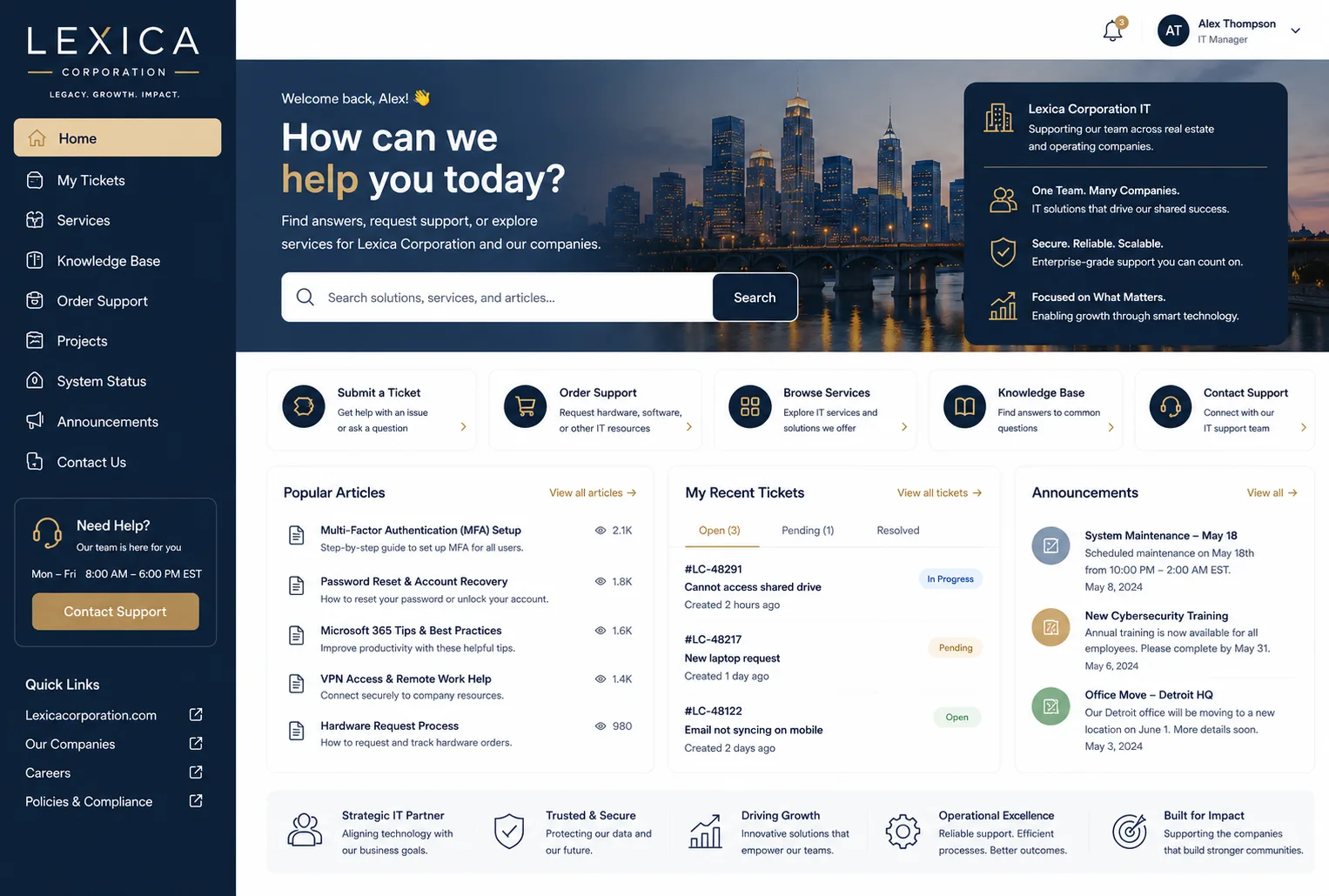
The counterintuitive insight: better automation doesn't eliminate helpdesk jobs—it shifts your team from reactive firefighting to proactive support strategy.
5. Design with Employee Adoption as Your North Star Metric
Here's the honest truth: your transformation will fail if employees don't use it.
Adoption isn't about forcing people to adopt—it's about making the portal so obviously better than the alternative that people choose it naturally. That means ruthless simplification. Every click should have purpose. Every field in your ticket form should earn its spot.
Test your design with actual employees before you go live. Not IT people. Real business users who are juggling 12 things and have 90 seconds to submit a support request. If they can't complete a ticket form in under two minutes, you need to simplify further.
Also: make it fast. Portal speed matters more than you think. A half-second delay increases abandonment. A two-second delay essentially kills adoption. This isn't vanity—it's behavioral economics.
6. Implement Data Migration and Integration Strategy
Your new portal is only as good as the data behind it and its ability to talk to your other tools.
Plan for clean data migration from your legacy system. That usually means deduplicating user accounts, validating email addresses, and archiving old tickets that clutter the view. You don't migrate everything—you migrate the relevant, clean subset.
Integration strategy connects your portal to your ticketing backend, your knowledge base, your chatbot if you have one, and any third-party tools your team uses (Slack, Teams, Jira, etc.). The more seamlessly these systems talk to each other, the better the experience for both employees and agents.
Most transformations stumble here because integration complexity gets underestimated. Budget 20-30% of your implementation timeline just for integration work and testing. It's worth it.
7. Establish Your KPIs and Measurement Framework

Transformation success lives or dies by measurement.
Your KPI framework should track employee-side metrics (portal adoption rate, ticket submission volume, self-service resolution percentage, employee satisfaction scores) and agent-side metrics (handle time, first-contact resolution, productivity per agent, ticket backlog).
Measure before transformation, measure at 30 days, 90 days, and quarterly thereafter. Ascend Portal Experience recommends baseline-setting before you even begin implementation—knowing your starting point makes the gains obvious and defensible to your CFO.
Agent productivity gains should be quantifiable. If transformation doesn't result in measurable improvements—fewer tickets per agent handled, faster resolution times, or higher satisfaction—then your implementation methodology needs adjusting.
Why Strategic Advisory Matters in This Work
Here's something that often gets overlooked: transformation success requires both deep product knowledge and industry-specific customer expertise.
You can't just hand a Freshservice instance to a developer and expect a world-class portal to emerge. You need people who understand both your platform's capabilities and your business context—what problems matter most, what employee pain points drive the most support volume, where automation creates the biggest wins.
That's why the Ascend Professional Portal Package combines implementation expertise with advisory guidance. It's not just about building something that works technically—it's about building something that transforms how your entire organization experiences support.
What This Transformation Actually Delivers
When you execute a thoughtful helpdesk portal transformation strategy, the results compound:
- Employees submit more tickets through the portal instead of via email or phone (reducing noise)
- Support team resolves more issues without escalation (reducing cost)
- AI and automation handle routine requests, freeing agents for complex work (improving morale)
- Self-service resolution increases, mean time-to-resolution decreases (improving satisfaction)
- Your IT team gets credit for a visible, usable system instead of blame for a clunky one (improving perception)
That's a win across every dimension—employee experience, operational efficiency, business reputation, and agent job satisfaction all moving in the right direction simultaneously.
The organizations that get this right don't view their helpdesk portal as a back-office tool. They treat it as a strategic business asset that directly influences how thousands of employees perceive IT support quality. That mindset shift is where transformation actually begins.
Getting Started with Your Transformation
If your current helpdesk portal feels disconnected from your brand or your business reality, a transformation strategy is worth serious consideration. The first step is always assessment—understanding what's working, what isn't, and where the biggest opportunities live.
Many organizations find that working with experienced implementation partners accelerates timelines and improves outcomes. The expertise compounds: professional teams have seen what works across dozens of deployments, which patterns drive adoption, and which shortcuts create technical debt later.
If you're using Freshservice and ready to move beyond the default experience, Ascend Portal Experience specializes in exactly this work—transforming generic helpdesk portals into branded, user-centric experiences that drive measurable business outcomes with fixed-price certainty.
Related: Best Branded IT Helpdesk Portal Solutions 2026: Top 5 Ranked
People Also Ask
What's the typical timeline for a helpdesk portal transformation?
Most transformations from assessment through go-live take 3-6 months, depending on complexity and customization depth. Simple implementations (improved design, basic automation) take the shorter end. Complex implementations (major integration work, AI implementation, multi-system migrations) take the longer end. Factor in an additional 4-6 weeks for user testing and refinement before you flip the switch.
How much should a portal transformation cost?
Budget varies widely based on scope, but expect fixed-price engagements in the $25K-$75K range for mid-market organizations. That typically covers strategy, design, customization, integration, testing, and launch support. The investment pays for itself within 6-12 months through improved adoption and agent productivity. Organizations that treat this as a one-time cost rather than an investment in ongoing competitive advantage usually regret it.
Can we do a helpdesk portal transformation without disrupting our current operations?
Yes, if you plan correctly. Most implementations run in parallel—your existing portal keeps running while you build and test the new one in a staging environment. You then migrate gradually or do a cutover event depending on your risk tolerance. Proper planning means zero downtime and no loss of ticket history.
What's the most common mistake organizations make with helpdesk portal transformation?
Underestimating change management and user adoption. Organizations build technically perfect portals that employees refuse to use because no one explained why it's better, or change was poorly communicated, or training didn't happen. The tool matters, but adoption strategy matters more. Second most common mistake: treating it as a one-time project instead of an iterative process. Portals need continuous optimization based on usage data and feedback.